
EnFEM 是一款通用的有限元分析(FEA)软件,用于模拟固体材料在各种荷载作用下的二维力学行为。该软件提供多种线性及非线性材料模型、边界条件和单元类型,能够解决从简单的线性弹性分析到复杂的非线性、多阶段土-结构相互作用等各类问题。这些功能使 EnFEM 成为岩土工程与结构工程领域的理想工具。
可用版本: 2026.x , …
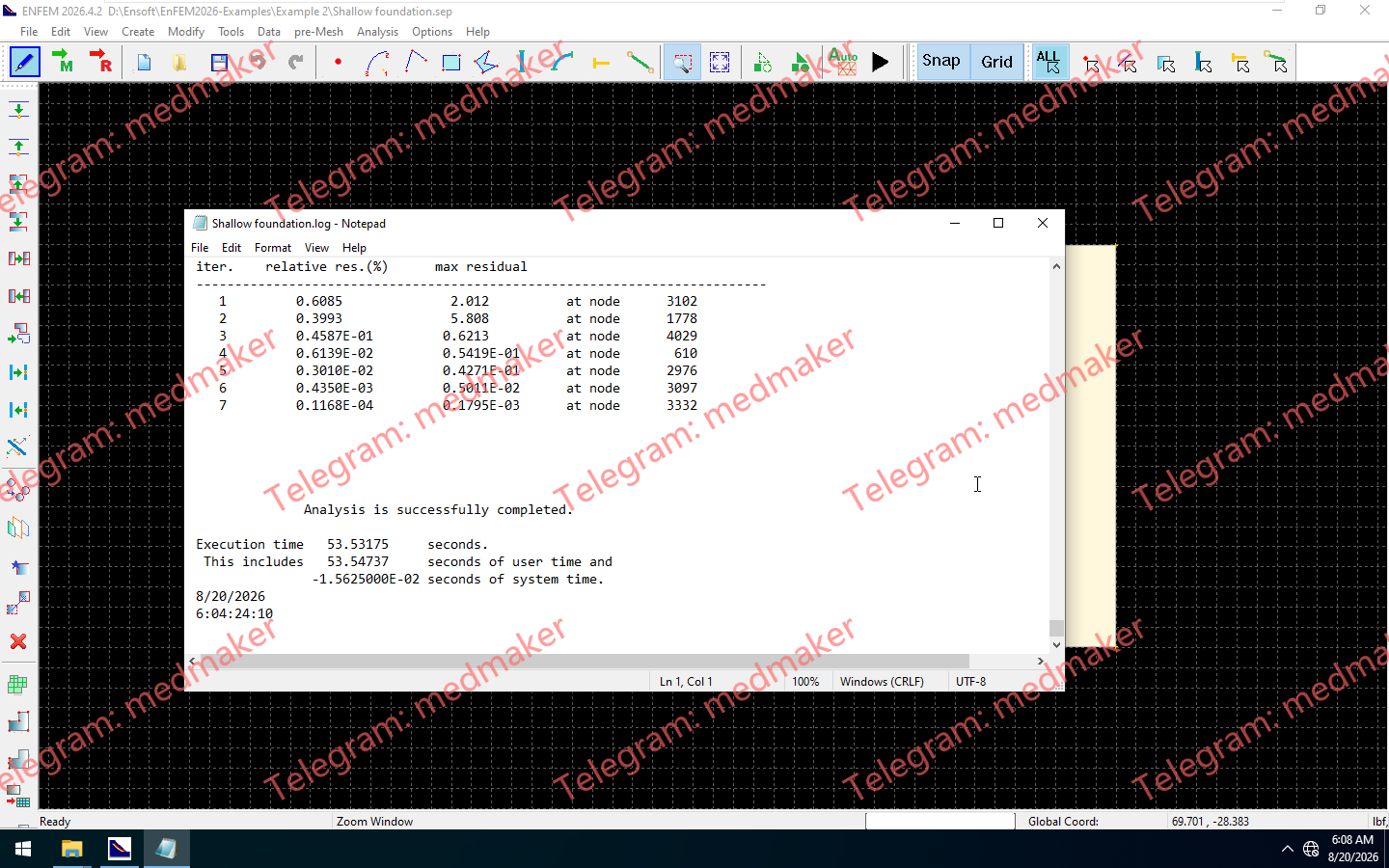
Ensoft ENFEM 2026.4.2
Build Model Once in PYWall and run analyses in both PYWall and EnFEM
Build Model Once in PYWall and run analyses in both PYWall and EnFEM. Using the new import function in EnFEM, users can import models built in PYWall. With the auto mesh generation function, user can run an finite element analyses with just a few mouse clicks.
The current version of EnFEM includes a built-in Strength Reduction Method (SRM) for finite element slope stability analysis. With an import function, users can quickly import an EnSlope or UTEXAS4 data file and perform an SRM slope stability analysis within minutes. The SRM finite element analysis consists of two stages. In Stage 1, gravity, tieback forces, and surface loads are applied. In Stage 2 (the SRM stage), the soil strength is incrementally reduced until convergence can no longer be achieved. The resulting safety factor is typically determined based on the maximum allowable deformation.
Benefits of Finite Element Slope Stability Analysis
There are two main benefits of conducting a finite element analysis for slope stability. The first benefit is that the critical slip surface develops automatically as shear strength decreases in the SRM stage. There is no need to assume a predefined slip surface (as is needed in a limit equilibrium analysis). For slopes with complex geometries, the SRM finite element analysis is a powerful tool for validating the critical slip surface identified from traditional limit equilibrium analysis. The second benefit is that, in finite element analyses, material properties are modeled as elastic-plastic, whereas in limit equilibrium analysis, they are assumed to be rigid-plastic. Material stiffnesses can alter the failure mechanism. This effect is more pronounced for slopes that are reinforced with structure elements (e.g. tiebacks or reinforcements).
When to use EnFEM for slope stability analyses?
(1) When the critical slip surface is complicated:
In this example, there is a stronger layer underneath a softer layer in this slope model. It is difficult to find an irregular slip surface with Limit Equilibrium Method (LEM).
(2) When the safety factor is limited by soil-structure interactions:
In this example, as soil mass slides down slope and the concrete facing is held relatively in place by the tieback, a slip surface can develop between soil and concrete facing. LEM can’t consider this type of failure mechanism.
Geostatic Stress and Multi-Stage Analysis
EnFEM allows for multi-stage analysis in simulating sequentially applied loads, as well as geostatic (initial) soil stresses, and excavations. For geomechanical problems, an initial stress field is often specified as the first analysis stage, commonly referred to as a geostatic step, during which soil particles have stresses due to self-weight but are free of deformation. EnFEM takes user-specified input and estimates the initial stress field. These features allow EnFEM to effectively analyze stress and deformation, and support the design of staged excavations.
Contact Elements Capable of Material Separation Simulations
Soil-structure interaction with computational contact analysis, is common in geotechnical engineering. EnFEM uses versatile and robust approaches, including penalty methods, for enforcing contact constraints between conforming or non-conforming meshes. EnFEM is able to simulate material separation and finite sliding along contact interfaces. Both, tie, and free-face options are also available in EnFEM.
More Information in English: Ensoft ENFEM 2026.4.2