
Welcome:
All Engineers

Altair SpiceVision PRO 2026.0 Win/Linux64

SpiceVision PRO takes SPICE netlists and models and generates clean, easy-to-read transistor-level schematics, circuit fragments, and design documentation to speed up circuit design, debug, and optimization at the transistor-level.


Available versions: 2026.x , 2025.x ,…
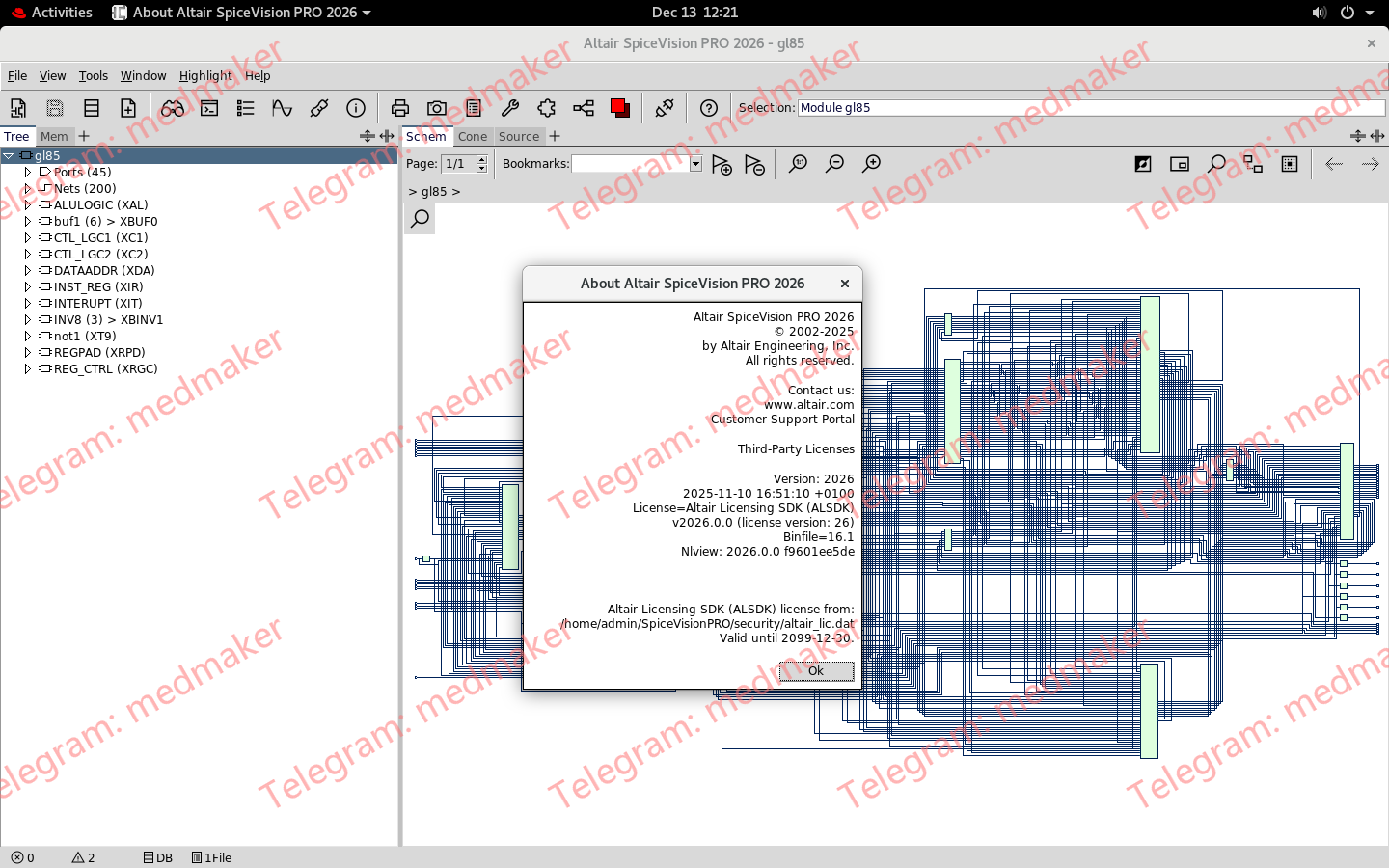

Altair SpiceVision PRO 2026.0 Tested Picture

Advanced Debug and Analysis

Interactive Cone Window – To accelerate debug, critical circuit portions can be graphically displayed in the Cone Window. Developers can concentrate on critical circuit fragments, with links to the original SPICE source code, while ignoring irrelevant design areas. This highly interactive view allows engineers to automatically build up critical paths through a design to rapidly find bug drivers. Complex bugs may be located and fixed quickly and easily. Circuit fragments displayed in the cone windows can easily be exported to a simulator as separate SPICE files (SPICE netlist export), for partial simulation, often running 10 to 100 times faster than the full circuit simulation.

Powerful GUI Cockpit – The GUI cockpit displays multiple hierarchy levels, from a top-level overview to all the lower level sub-circuit views. Design hierarchy tree, source code and schematic diagrams are shown across multiple windows, while object drag and drop between the different windows make it easy to understand the SPICE netlist under investigation. The user can select areas of interest from a results list, generated by a powerful search engine and let SpiceVision PRO automatically render circuit diagrams to assist engineers to visually explore circuits and to eliminate bugs in their designs.

Automatic Circuit Simplification – SpiceVision PRO can automatically simplify complex circuits, merging multiple parallel or serial components, such as capacitors or resistors, into single components of the same type. For example multiple resistors connected in series (in the SPICE netlist) can automatically be merged into one single resistor in the SPICE schematic view (in the GUI cockpit). This method of simplification makes it easy to analyze post-layout netlists or I/O circuit structures where we often ‘see’ combinations of both series and parallel structures.

Automatic Logic Recognition – The built-in automatic logic recognition engine of SpiceVision PRO creates digital logic symbols and schematics from pure SPICE-level netlists for easy design exploration.

Tool Customization

Customization with UserWare – A Tcl based UserWare application program interface (API) allows access to the internal database and graphical user interface (GUI). Users can analyze the design data and generate user-specific design reports and checks. The UserWare API also allows SpiceVision PRO to be closely integrated with different design flows and third party tools. SpiceVision PRO comes with a complete range of specialized UserWare features. These 100+ UserWare examples are available as source code and can be used as template code to accelerate customer specific project development.

UserWare Plugin Mechanism – In order to make it easy for organizations to manage and deploy customized tool features within an organization, SpiceVision PRO comes with a smart UserWare plugin mechanism that makes it very easy to add, remove and manage customer defined tool features within development teams and organizations.

Specialized Capabilities

Post-Layout Debugging – Layout extraction tools generate very large and complex netlists. The parasitic analysis option for SpiceVision PRO allows visualization and analysis of such parasitic networks (DSPF, RSPF, SPEF) and provides capabilities to prune and export SPICE or SPEF netlists for fast critical path simulation.

IP Verification and IP Reuse – Specific parts of a design can be “cookie-cut” (extracted) from the complete design and saved as a separate SPICE netlist for use as new IP or for detailed SPICE simulation.

Cadence Schematic Interface – Starting with pure netlist information the Virtuoso schematic editor interface option, that makes use of the Cadence SKILL language, automatically generates critical path schematics or schematics of larger IP blocks and exports these schematics into the Cadence schematic editor environment for further editing, IP reuse or simulation.

Analog Waveform Viewer and Signal Tracing – SpiceVision PRO offers integrated analog waveform viewing as an option. The analog waveform viewer allows design engineers to see the signal transitions over time and the relation of those signals with other signals in a design. Using signal drag and drop between the schematic window and the waveform window allows easy signal tracing and detection of simulation problems.

Supported Input File Formats

SpiceVision PRO: SPICE, HSPICE, Spectre, Calibre, CDL, Eldo and PSPICE
Parasitic Analysis Package: DSPF, SPEF and RSPF
Analog Waveform Viewer: Different analog waveform formats

Supported Output File Formats

SpiceVision PRO: Generic SPICE netlist export
Parasitic Analysis Package: SPEF netlist export
Cadence Schematic Interface: Fully editable schematic design from pure SPICE netlist information


COMMENT Get first!

Must log in before commenting!


Sign In

Forgot Password

Sign Up